
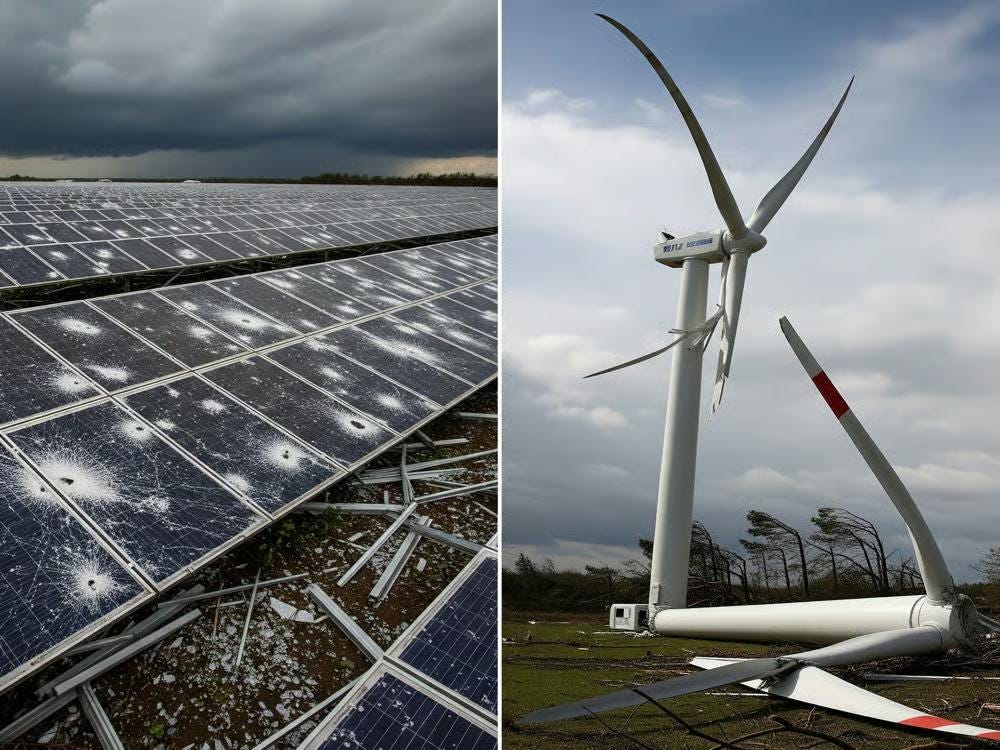
The most common failure mode of intermittent renewable generators is failure to generate when needed because there is low/no solar or wind. The approach to dealing with this failure mode is the addition of storage capacity to deliver power during periods of low/no solar or wind. Resolving this failure mode requires additional renewable generation to charge storage and sufficient suitable storage to supplement or replace renewable generation during periods of low/no renewable generation of whatever duration. However, there is currently no storage technology suitable for multi-day or seasonal storage.
Recent experience with solar photovoltaic generation has demonstrated its susceptibility to damage from high winds (including tornadoes) and hailstorms. There is probably no realistic protection from direct tornado impact. However, there appear to be potential approaches to avoiding or minimizing wind and hail damage. Many recent industrial solar installations include the ability to track changes in solar altitude throughout the day to improve capacity factors and maximize energy collection. Increasing the potential range of rotation to permit the collectors to be rotated to the horizontal position, facing the ground, would decrease wind loading on the collectors and their mountings and protect the collection surface from direct impact by hailstones.
The ability to rotate the collector arrays to the vertical position would also avoid snow accumulation on the collector surfaces. This would allow the collectors to function after the snowfall, even if accumulated snow remained below the collector arrays, as long as the collector arrays were installed high enough to permit the collectors to rotate into tracking position without interference from the accumulated snow. This would avoid the generation failures experienced following winter storm Fern, when persistent cold weather caused snow to remain on collector surfaces for multiple days, preventing solar collection.
Wind generators are also susceptible to damage from high winds (including tornadoes), hail damage to turbine blades and fire damage to turbines and blades resulting from lightning strikes. Hail damage to turbine blades, while expensive, can be resolved through blade replacement. Damage resulting from turbine fires typically results in destruction of the complete turbine and blade assembly, since these fires occur at altitudes which make firefighting impractical, if not impossible.
The most destructive failure mode for wind turbines is failure of the monopole (unipole) supporting the turbine and blade assembly, which typically results in destruction of the entire wind turbine installation with the exception of the reinforced concrete base structure.
Renewable generation infrastructure is significantly more fragile and prone to damage than nuclear, coal and natural gas generators. Failures spread debris over the installation sites, including broken glass and turbine blade fiber structures. Wind turbine fires also result in significant air pollution from the uncontrolled combustion of lubricating oils in the turbine gearboxes and combustion of turbine blades.
Current battery energy storage system (BESS) installations are prone to fires which can destroy one or more batteries and emit highly toxic smoke plumes requiring evacuation of surrounding residential and commercial buildings. These fires are extremely difficult to extinguish and are frequently allowed to burn themselves out to avoid soil pollution from contaminated water.
Originally published here.
Wind energy has been the greatest scam on the ratepayers and taxpayers of the world for over 30 years and only now is it starting to be exposed for the crime it is!
whirly-gigs & sparky billboards = waste and fraud