Consequences
Intended, Unintended and Anticipatable

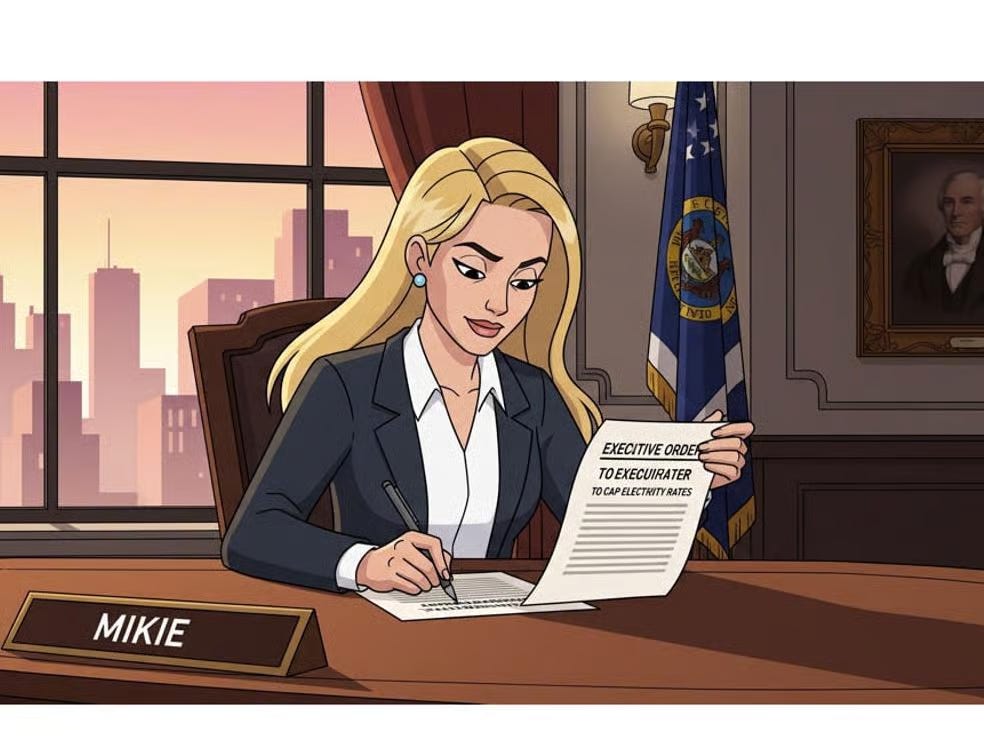
The politically promoted concern about “affordability” rapidly focused on electricity rates as a target rich environment. In one sense this is not surprising, since electricity is used almost universally and thus affects virtually everyone. In another sense it is surprising, since electricity is one of the most heavily regulated commodities in the economy.
New Governor Mikie Sherrill issued two executive orders immediately after her inauguration. Executive Order 1 ordered a freeze on electric utility rate increases by the NJ Board of Public Utilities. Executive Order 2 declared a state of emergency and initiated programs to create a major expansion of electric generation capacity in the State, initially primarily renewable generation and storage. Other politicians have called for electric rate caps.
The intended consequences of these actions are to prevent further increases in electric rates. Unfortunately, intended consequences are often accompanied by unintended consequences. For example, the NJ rate increase freeze prevents utilities from being compensated for investments already made and recovery of costs already incurred. The unintended consequences of this freeze include effectively discouraging NJ utilities from making any incremental investment in facilities and equipment in excess of the depreciation of existing facilities and equipment. This is likely to result in reduced system reliability over time.
The intended consequences of executive order expanding in-state generation include reducing reliance on electricity imports from the PJM grid and advancing the transition to renewable generation. The unintended consequences of this executive order include further increases in electricity costs which would have to offset by some form of state funding. While the investments in renewable generation and storage would likely be made by third party merchant generators, the investments in transmission infrastructure to connect the new generation to the grid would be the responsibility of the utilities.
The utilities would likely be extremely reluctant to make those investments because of the rate increase freeze. The connection of new renewable generation capacity would not result in increased electricity sales volume and increased utility revenue. Rather, the additional renewable generation would further displace the output of existing generation resources, increasing the cost of their capacity contracts.
Rate caps place utilities in a very difficult and potentially dangerous situation, since their prices are capped, but their upstream costs are not capped. The costs of replacement wires, transformers and other materials are not capped and could continue to rise, and they are already far more expensive than the value of the depreciated equipment they would replace. The wages of their employees and the cost of the vehicles used for their operations are also not capped.
Finally, the second executive order assumes that increased renewable generation and storage would stabilize or reduce electric rates. However, the experience of the states which have led the transition to renewable generation suggests that rates would increase rather than decrease. Further, those states have increased renewable generation with minimal or no storage capacity increase. Storage capacity is far more expensive than generating capacity and also has a much shorter life.
Originally published here.
One must wonder what it is about American politics that attracts such morons to public office. Clearly, nobody ever told these morons that they cannot re-write the laws of physics (particularly thermodynamics) or the laws of economics.
And every day the voting populace seems to get dumber.
MD
Identical situation to mandating renewables to "solve" climate change by relying on the same weather causing that disaster?